
For a small business, startup, local service provider, publisher, or growing company, getting a website often feels like a simple task.
Find a company. Choose a design. Share your logo and content. Pay the invoice. Launch the website.
But that is only the easy part.
A website can look beautiful and still do very little for the business. It can sit online for years without bringing enquiries, helping customers, answering common questions, or building trust.
That is why the real question is not:
How do I get a website made?
It is:
What should my business do online, and how should my website help me do it?
That small change in thinking can save a business a lot of money and frustration.
Why an online presence matters today

People rarely judge a business only by what they see offline anymore.
Before calling you, visiting your office, asking for a quotation, or making a purchase, a potential customer may search for your business online.
They may check your website.
They may look at Google reviews.
They may look at Instagram or LinkedIn.
They may search for your services.
They may compare you with two or three competitors.
Sometimes they are not even consciously doing all of this. They are simply trying to answer one basic question:
Can I trust this business?
A good online presence helps answer that question before you ever speak to the customer.
For a local business, that might mean a Google Business Profile, a clean website, accurate contact details, reviews and social profiles.
For a software company, it could mean product pages, documentation, pricing information, demos and customer support.
For a news organisation, the needs are completely different again.
So there is no single online presence that works for every business.
What does a business actually gain from a website?
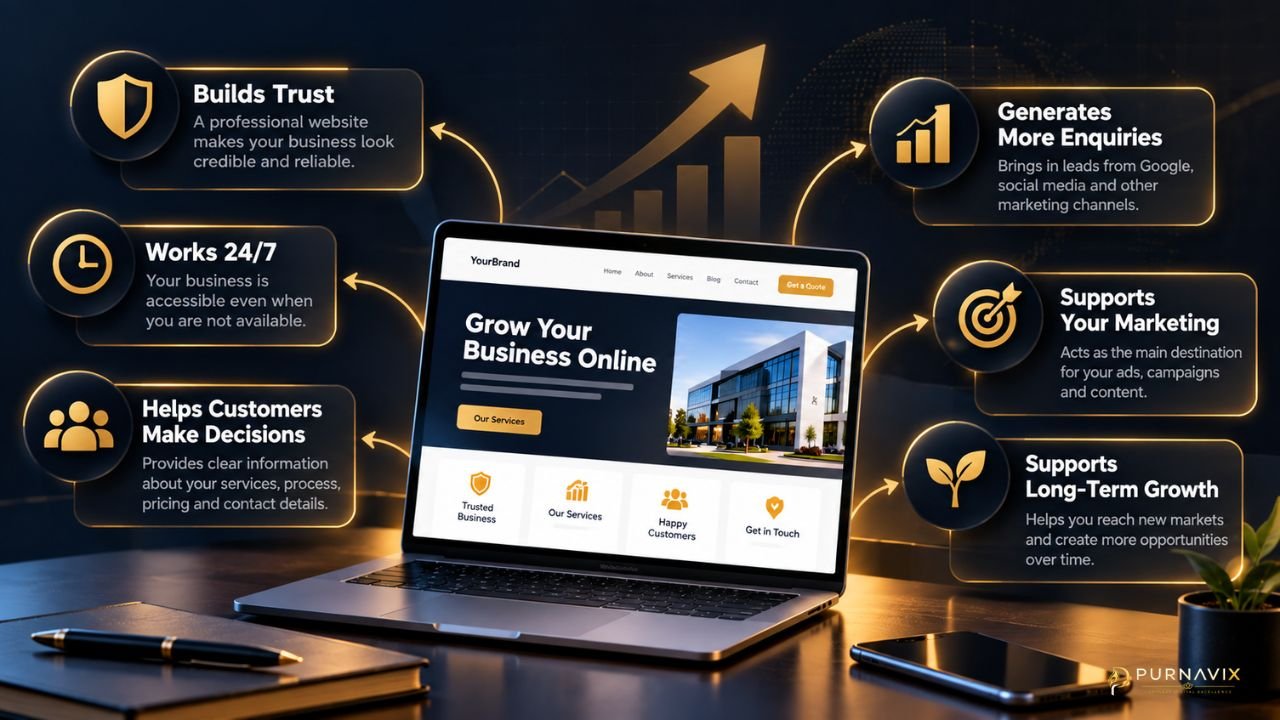
A website is not automatically useful just because it exists. Its value comes from what it helps your business achieve.
1. It builds trust
A professional website gives people a place to learn about your business without relying entirely on sales calls or social media posts.
They can see who you are, what you do, where you are based, what services you offer and how they can contact you.
A website cannot create trust on its own, but a poor website can certainly reduce it.
2. It works when you are not available
Your office may close at 7 PM. Your sales team may not answer every call. You may not be online all day.
Your website can still explain your services, show your work and collect enquiries.
That does not mean every visitor becomes a customer. It simply means the business is available online even when the team is not.
3. It helps customers make decisions
Good websites answer questions.
How much experience do you have?
What exactly do you offer?
Who do you work with?
How does the process work?
Where are you located?
Can I see examples?
What happens after I contact you?
The more useful information you provide, the less uncertainty a potential customer has.
4. It gives your marketing somewhere to go
You can spend money on Google Ads, social media, content, email marketing or other campaigns.
But eventually, people need somewhere to land.
Your website becomes the place where your marketing efforts meet your actual business.
Do you need an expensive website?
Not necessarily.
This is one of the biggest mistakes businesses make.
A small local business may need a simple, well-built website with five or six strong pages.
Another company may need a customer portal, online payments, user accounts, an admin system and several integrations.
These are completely different projects.
A business should pay for what it actually needs, not for a list of trendy features.
The right budget depends on:
the number of pages
design requirements
content
integrations
e-commerce or payments
user accounts
custom functionality
CMS requirements
SEO needs
maintenance and support
A ₹10,000 website and a ₹5 lakh web platform are not competing products. They solve different problems.
What should you prepare before hiring an agency?
This step is often ignored.
Many businesses contact an agency and simply say:
We need a website. How much will it cost?
That makes it difficult for both sides.
Before speaking to agencies, write down a simple project brief.
It does not need to be professionally written.
Just answer a few questions:
What does your business do?
Who are your customers?
What do you want the website to achieve?
What pages do you expect?
Do customers need to buy something online?
Do you need forms, bookings, memberships, login accounts or payments?
Do you already have branding, photos and content?
Do you have examples of websites you like?
Who will manage the website after launch?
Do you have a target launch date?
You do not need every answer before contacting an agency. But having a basic understanding of your business goals will make every conversation better.
How to choose the right web development agency
This is probably more important than choosing the design.
Do not choose an agency only because its homepage looks impressive.
A good agency website is not proof that the agency will build a good website for you.
Look deeper.
Look at their previous work
Ask to see real projects.
Do the websites still work?
Are they similar in complexity to what you need?
Can the agency explain what it actually built?
A portfolio full of screenshots is less useful than a portfolio that explains the project.
Ask who will actually build the website
Some agencies have an internal development team.
Others outsource most of the development.
Neither model is automatically wrong, but you should know how the work is handled.
You do not want to assume you are working with a senior developer and discover later that the project has been passed between several people.
Ask about technology
You do not need to become a developer before hiring one.
But you should know what is being proposed.
WordPress, Laravel, Next.js, Shopify, a headless CMS and a fully custom application all have different strengths.
The agency should be able to explain why a technology is suitable for your project, not simply tell you that it is “the latest technology.”
Ask what happens after launch
This is a big one.
What happens when the website goes live?
Who updates it?
Who fixes bugs?
Who handles security updates?
What if you need a new page six months later?
What happens if the server goes down?
A website is not always finished on launch day. Many businesses need ongoing support.
Be careful with unrealistic promises
Be cautious if an agency promises:
guaranteed Google rankings
guaranteed sales
overnight SEO results
a huge increase in traffic without explaining the strategy
an extremely complex website in an unrealistically short time
Good agencies should be confident, but they should also be honest about what they cannot guarantee.
Do not choose an agency only on the lowest price
Price matters.
But comparing agencies only by price can be misleading.
Suppose one agency quotes ₹30,000 and another quotes ₹1,20,000.
That does not automatically mean the second agency is expensive.
You need to compare what is actually included.
Does the price include design?
Content setup?
SEO structure?
Mobile optimisation?
Speed optimisation?
Forms?
Payment integration?
Testing?
Hosting?
Maintenance?
Support?
A cheaper project can become expensive later if basic requirements were excluded from the original quote.
Ask for a clear scope instead of simply asking:
“What is your lowest price?”
Make sure you own your website
This is something every business should clarify before signing a deal.
Ask who owns:
the domain name
hosting account
website source code
design files
business email
analytics accounts
Google Business Profile
advertising accounts
payment gateway account
These should not be trapped inside an agency account that you cannot access.
Your agency should be a partner, not the gatekeeper of your own digital property.
Think about SEO from the beginning
SEO should not be treated as something added after the website is finished.
The website structure itself affects SEO.
Things like:
page titles
headings
URLs
internal links
crawlability
mobile experience
page speed
structured data
image optimisation
content structure
should be considered during development.
You do not need to turn every page into an SEO experiment. The basic goal is simpler:
Make the website useful for people and easy for search engines to understand.
Your website should be built for customers, not for the agency
This sounds obvious, but it is surprisingly common.
A business owner may be excited about animations, fancy sliders, 3D effects and modern design trends.
Customers may care more about:
What do you do?
Can you solve my problem?
How much does it roughly cost?
Can I trust you?
How do I contact you?
Good design supports those questions.
It should not hide them.
Mobile is not optional
A large part of your audience may first discover your business from a phone.
That means your website should not simply be a desktop website squeezed onto a smaller screen.
Buttons should be easy to tap.
Text should be comfortable to read.
Forms should work properly.
Images should load efficiently.
Navigation should make sense.
Important information should not disappear on mobile.
A website that looks beautiful on a desktop but feels frustrating on a phone is not finished.
What makes a website genuinely successful?
There is no single metric.
For one business, success may mean more phone enquiries.
For another, it may mean more online purchases.
For a software company, it may mean signups and subscriptions.
For a publisher, it could mean more returning readers and a better publishing workflow.
For a local service company, it may simply mean customers can easily find the business, check its credibility and request a quote.
The website should be designed around that goal.
One final piece of advice before you choose an agency
Do not rush the decision.
Talk to two or three agencies.
Ask similar questions.
Compare their answers.
Look at their previous work.
Read their proposal carefully.
Pay attention to how they communicate.
A good agency will usually ask you questions too.
They should want to understand your business before talking endlessly about design.
That is a good sign.
Because the best website is not necessarily the one with the most features or the most expensive animations.
It is the one that makes sense for the business behind it.
And when you find an agency that understands that, you are not simply hiring someone to build a website.
You are choosing the team that will help shape how your business appears online.